Cork-slip Prevention
The transfer of major forces in bamboo connections is challenged by the risks of splitting, especially at the ends. The tubular form of the culm is offering no planar faces for attaching metal force transmission fixtures.
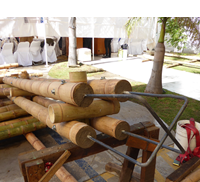
Column cluster to be embedded in concrete foundation
In Colombia devoted developers tried a new idea filling cement-mortar in bamboo inter-nodes and inserting rebars or flat steel strips partly sticking out. This way a robust force transfer outlet was created. Bolting and welding can now easily offer swift and secure connections of bamboo, even to other construction elements. Bamboo columns can be embedded in concrete foundations leaving a minor gap to avoid absorption of rainwater.
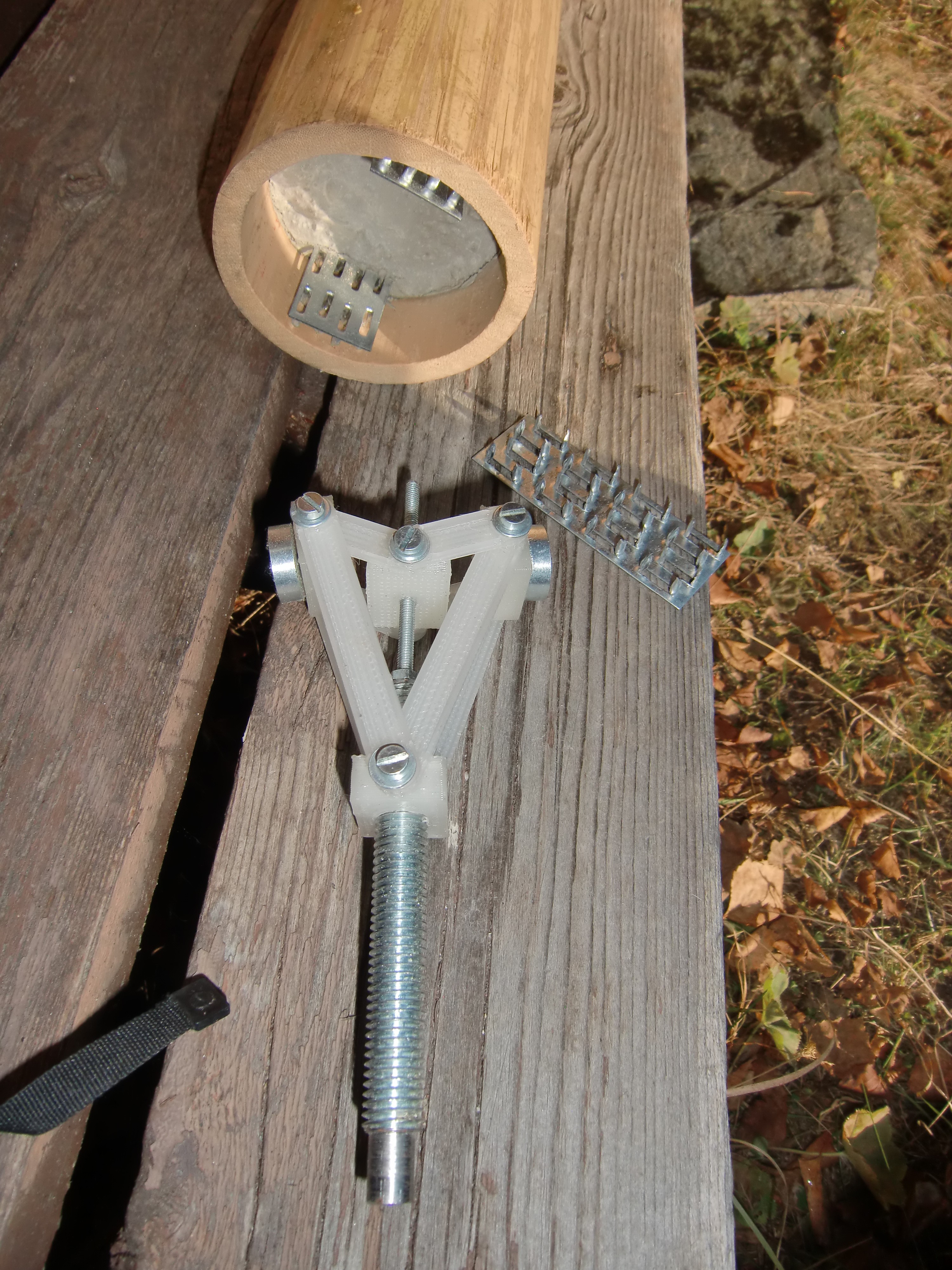
Sten Lundgren's toothplate expander
At the culm ends, with embedded rebars, there is a problem if the concrete shrinks too much and the whole construct pops out like a wine bottle cork.
An expansion tool was created by a Swedish engineer which permits thin dented steel plates to enter the inside of the bamboo culm end.
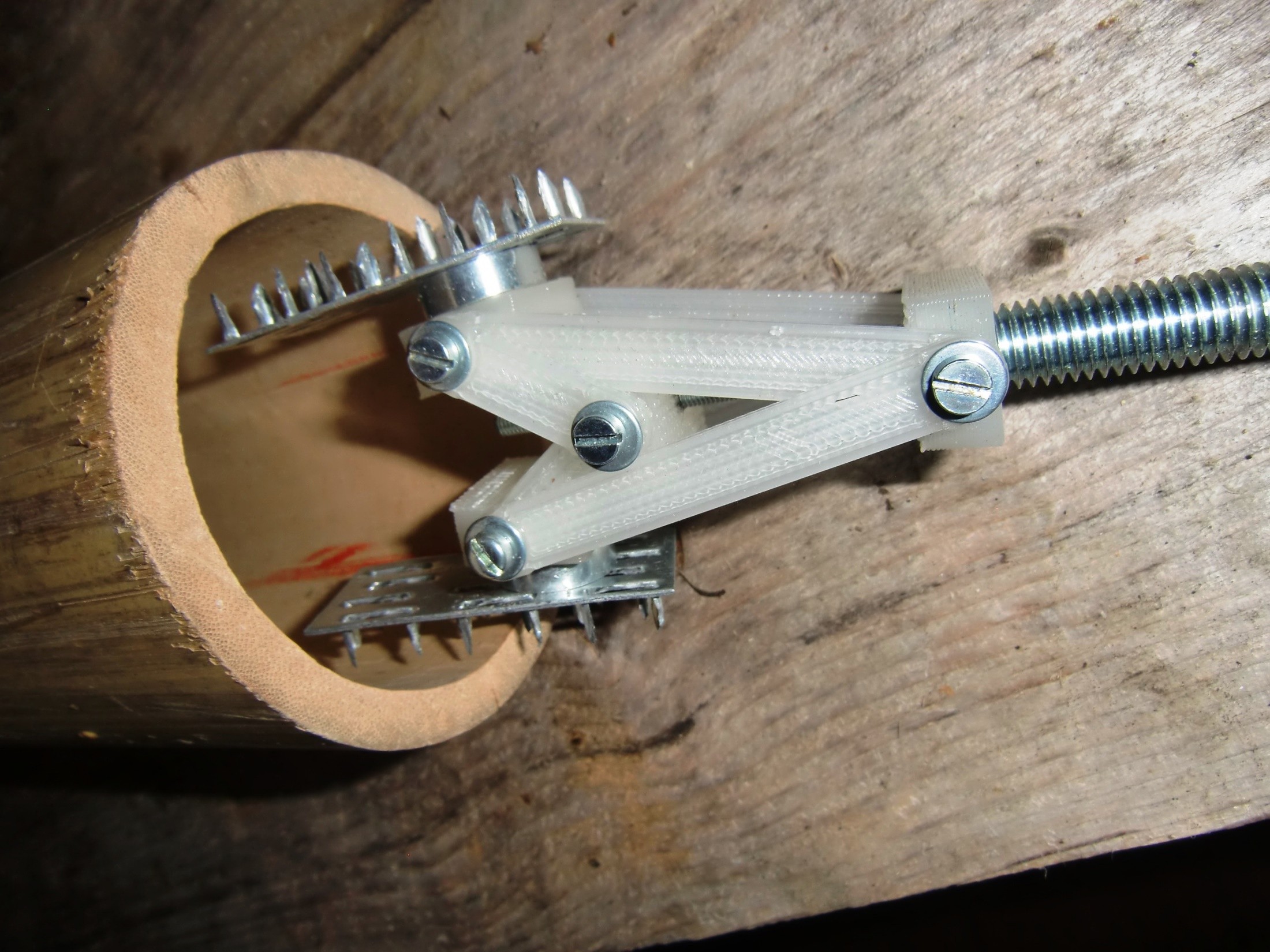

The thin dented plates may be possible to punch-out from food cans?
Depending on the geometry, a large number of such plates should prevent the cork pop-out effect.
Roof cover with Natural Rubber?
The idea came from long experience in the low-income world where poor people don’t have any other options than the rusting corrugated tin sheet....
Explanatory video...Thinking then of the tar roofing paper we had in Sweden for hundred years which still is in use for simple shelters. It is supported by a thin wooden panel which easily could be substituted with bamboo.
Details: AsphaltLayer+BamboMatFor cover, an interesting option is then a thin, woven bamboo mat stapled to slats as support. On top, a bitumen layer is spread and then sprinkled with light sand. The complete assembly can then be rolled over the ridge, eave-to-eave, and the slats fixed to purlins. If the purlins are cut slightly oversize, pressing them down when fixing, will create good rainwater run-off.
If Natural Rubber still is produced like in Brazil, Malaysia, Liberia? And if small-scale vulcanizing (basically heat+pressure) is possible, you have a new, fossil-free, waterproof roof cover!
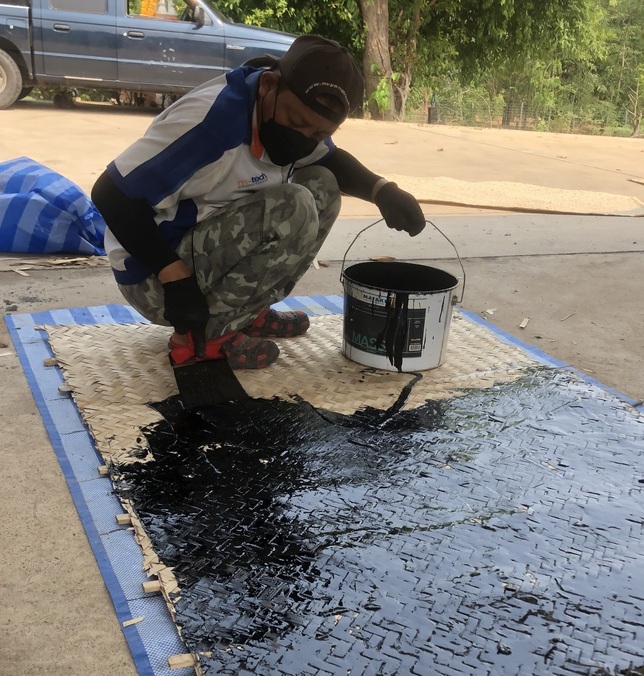
Tar on thin bamboo mat
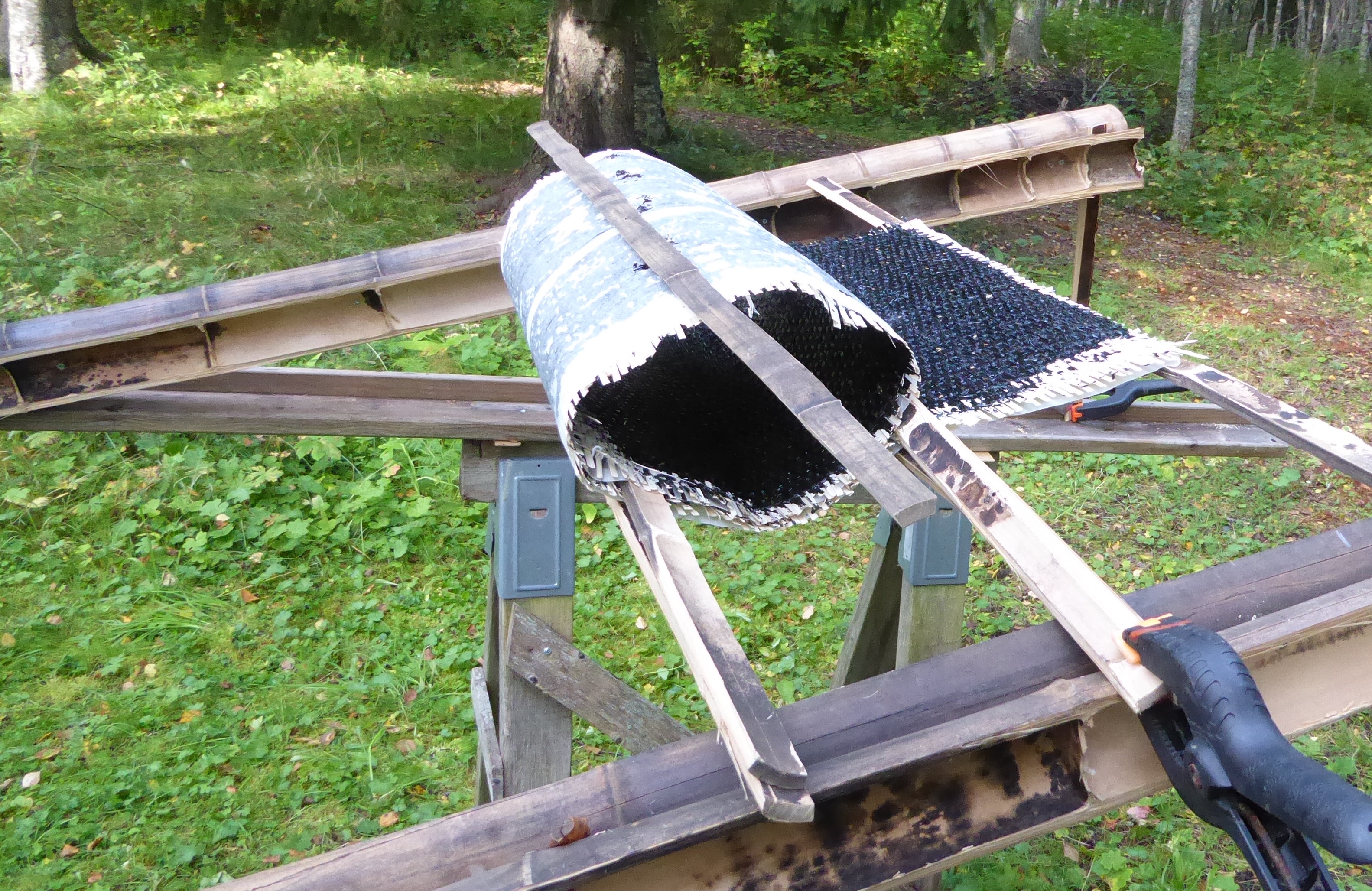
Entire roof cover between two purlins rolled out, eave to eave over the ridge.

Finally a thin layer of white sand as sun-UV protiection.
Formwork, usually from pinewood or plywood, for reinforced concrete beams, columns, slabs and foundations become a significant part of the construction costs. After the purpose designed-to-measure formwork has been dismounted only some parts may be recycled, the rest is usually scrapped.
Website under reconstruction - updates mostly on a daily basis.